
Exercises (3302)
Cover work
Light-Contact
Group work


Exercise 1:
Static form: From the shoulder-width boxing position, bounce a tennis ball (in a hoop) with one hand, keeping the other hand on your temple at all times. Change which hand is bouncing the tennis ball from time to time.
Exercise 2:
Dynamic form: Move the tennis ball between the rings (bouncing on the feet) without touching them.
Exercise 3:
On a command from the instructor ("top"), swap the tennis ball with a partner.
Exercise 4:
At the instructor's command ("top"), try to steal another participant's tennis ball without losing your own ball.
Exercise 5:
All against all (elimination match): whoever loses their ball is eliminated (possibly perform additional tasks).
Per participant:
1 tennis ball
1 tyre
Defensive zone defence (double-teaming in the corner and shifting within the block) / 3 vs. 2
Forms of play / exercises
Group work
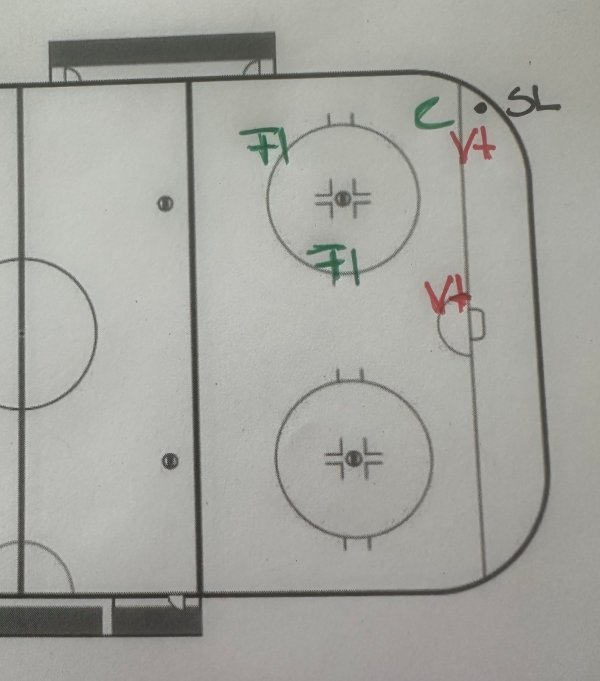
Organisation/programme:
Five players take up their basic defensive positions in the defensive zone. The coach takes up a position in one of the two corners with a puck.
A defender and the centre join the coach and work together to simulate double-teaming the opposing player in possession of the puck (double team).
The remaining three players take up their defensive positions:
Defender: Positions themselves in front of their own goal and secures the slot or the goal area (net front coverage).
Winger closest to the puck: Positions themselves level with the blue line near the boards on the side of the rink where the puck is.
Winger furthest from the puck: Also positions himself in the upper zone, but slightly further towards the centre of the rink and slightly deeper than his partner. He secures the slot and potential passing lanes in particular.
The coach changes sides with the puck. The players adjust their positions accordingly and move together as a defensive block (Defensive Zone Shift). This ensures that man-marking and coverage of the goal area are maintained.
After the side change (or several changes), the coach passes the puck to the centre.
The exercise then transitions into a 3-on-2 situation. The three attackers attempt to create a scoring opportunity against the two defenders.
Key areas/coaching points:
Consistent and coordinated double-teaming in the corner.
Communication between the defender and the centre.
Rapid repositioning of the entire block when switching sides.
Consistently securing the slot and the goal area.
Block passing lanes and control the opposition’s passing options (position of the wingers).
Switch quickly from defence to attack after winning the puck.
1/3 of the pitch (1 goal)
Stretching / mobility
Stretching
Do not perform any aggressive stretches; instead:
Lower body
Calf
Front of the thigh
Hamstrings
Glutes
Upper body
Chest
Shoulder
Latissimus
Neck
Hold for about 20–30 seconds, breathing calmly.
You can also turn this part into a gentle mobility sequence instead of doing traditional static stretching.
Diagonal stand
Coordination exercises
Individual work
Place one foot and the opposite hand on the slackline, stretch out the other limbs (horizontally) and hold the position. The closer the hand and foot are to each other, the less stable the position is; if they are further apart, you need good body tension.
Elevate:
Tap marked points on the ground with your hand; cat walk (move forwards from a diagonal position).
1 Slackline
Thief jump I
Parkour
Individual work
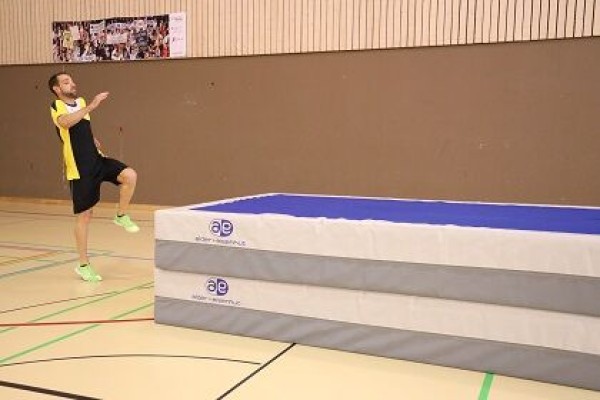
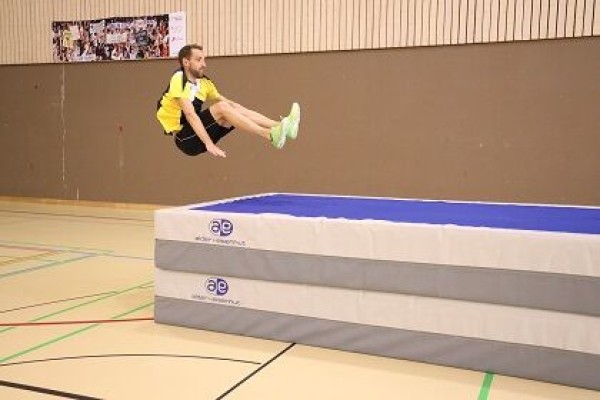
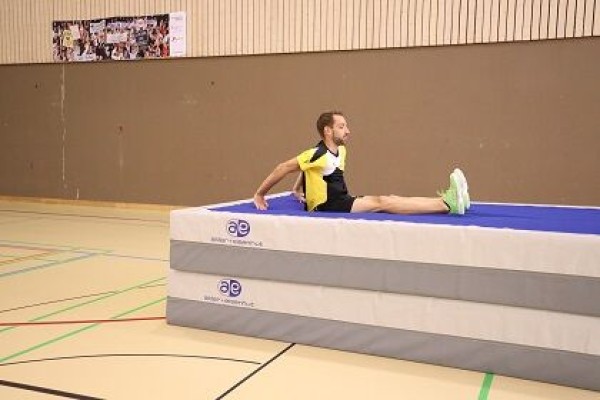
Strong run-up, frontal take-off approx. one leg length in front of two soft mats lying on top of each other, pull your legs up quickly in the air and bring them forwards in a horizontal position, hit the mat hard with both hands when landing in the seat.
Variant:
Lower mat height (only 1 soft mat).
2 soft mats (large)
Post structure:
Place two large soft mats on top of each other.
Thief jump II
Parkour
Individual work
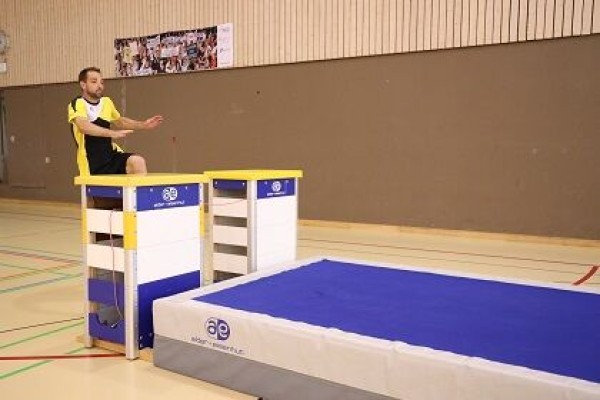

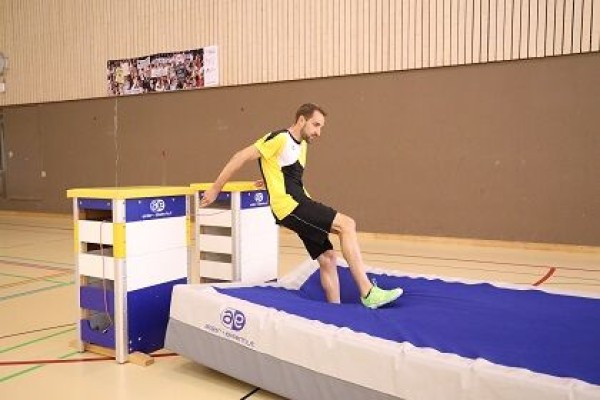
Strong run-up, frontal take-off approx. one leg length in front of the obstacles, pull your legs up quickly and bring them forwards in a horizontal position, push off the vaulting box with both hands.
Variant:
Vary the height of the box.
2 vaulting boxes/pommel horses
1 soft mat (large)
1 elastic rubber band
Post set-up:
Place two vaulting boxes next to each other at a distance of approx. 50 cm, place a large soft mat behind them, stretch an elastic rubber band between the vaulting boxes if necessary
Thief jump III
Parkour
Individual work
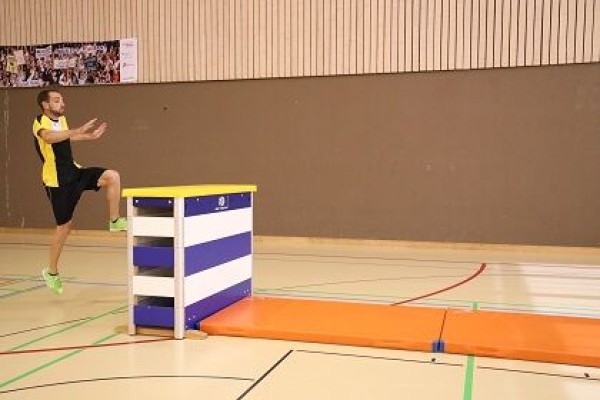
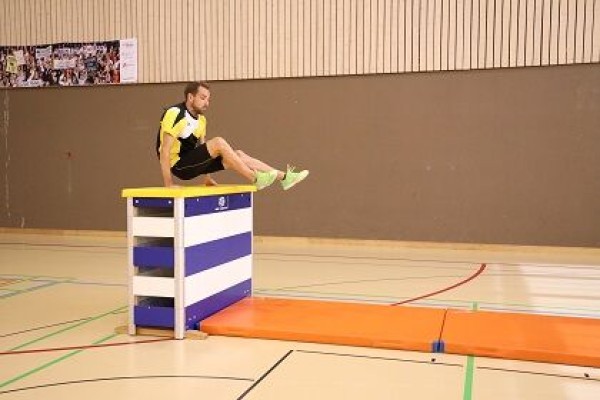

Strong run-up, frontal take-off approx. one leg length in front of the vaulting box, pull your legs up quickly and bring them forwards horizontally, push off the box forcefully with both hands to land, continue running directly after landing.
Variant:
Vary the height of the box.
1 Swedish box/pommel horse
Distance fitting
Stimulate circulation
Partner work
The binomial lines up on a line. Using passes, the pair must reach a defined target zone. One participant in the group moves away in the direction of the target. They decide for themselves how far they want to distance themselves from their partner. At the new position, they must be able to catch/receive the Frisbee/ball thrown/passed by their partner. If this is successful, the thrower may now approach the target and at the same time becomes the new pass receiver. If the pass attempt is unsuccessful, the frisbee/ball must be returned to the thrower by the catcher so that the thrower can start a new pass attempt (possibly at a shorter distance).
Variant:
Multiple groups of 2 compete against each other. The winning binomial is the one that is the first to return to the starting line after the start command from the sports director in compliance with the rules described above.
Per participant:
1 bat/stick ►intercross/lacrosse, smolball
Per group of 2:
1 throwing disc (frisbee)/ball ►frisbee ultimate, basketball, FooBaSKILL, handball, intercross/lacrosse, smolball
4 marking cones/caps ►start and finish line
Distance collector
Coordination exercises
Individual work
The participants form two groups, each of which is assigned to a slackline. Now the participants, one after the other, walk as far as possible along the slackline. The distances travelled by the individual participants are added up. Which group covers a greater distance
Difficulty:
Only metres walked backwards count
1 Slackline
Double passing game
Coordination exercises
Partner work
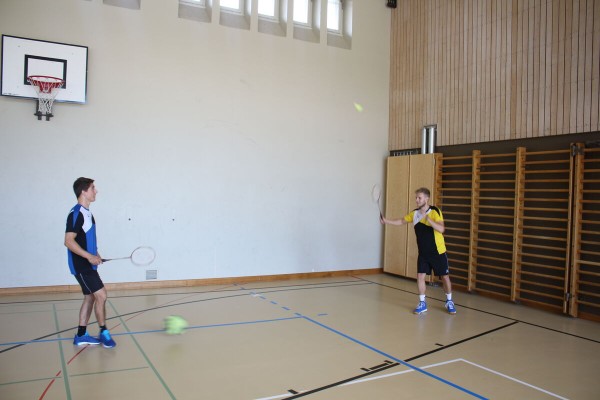
Two participants stand opposite each other at a distance of 3-5 metres and simultaneously pass a football and a shuttle back and forth with badminton rackets.
Variant:
Pass the football and shuttle at the same or opposite pace.
► Differentiation skills, orientation skills, reaction skills
Per group of 2:
2 badminton rackets
1 badminton shuttle
1 football
Swivel squat I
Parkour
Individual work


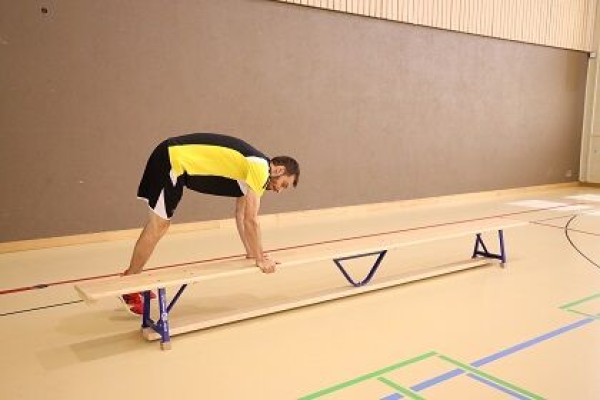
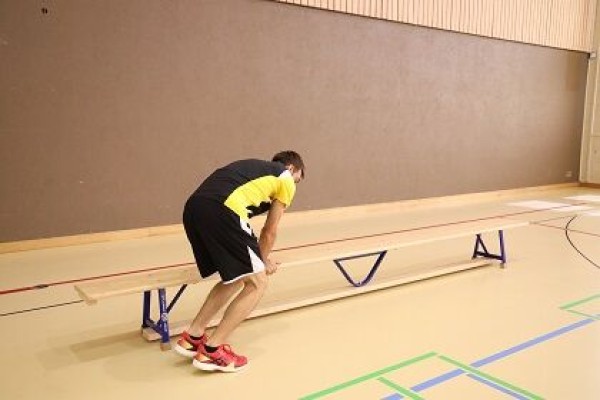
Stand on one side of the long bench, hold on to the edges of the wide side of the long bench with your hands, jump over the bench in as high a squat as possible (squat turn), land on the other side of the long bench.
Variant:
Place balls on the long bench, over which the legs must be guided.
1 long bench
2-3 medicine balls ► Variation of the exercise
Swivel squat II
Parkour
Individual work
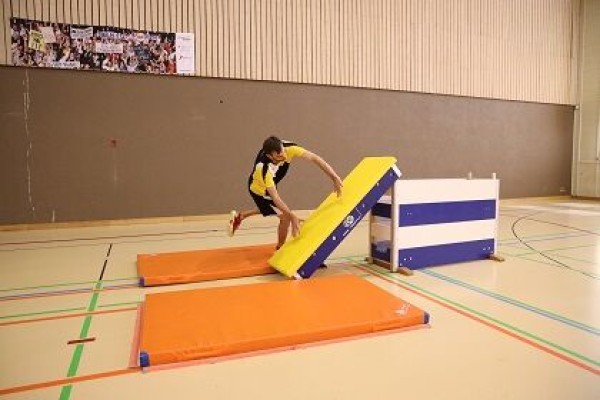
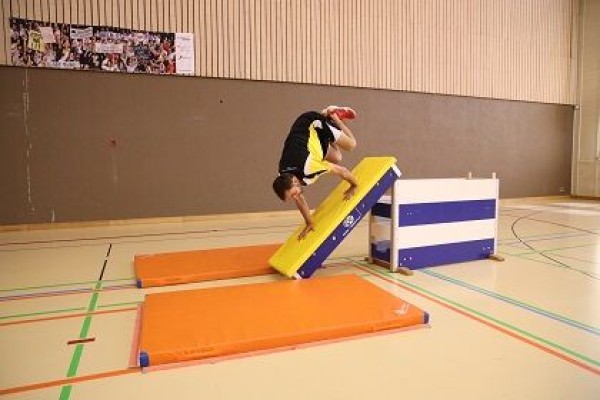

Slow run-up, place your hands on the top of the vaulting box (the upper hand points horizontally in the direction of the jump, the lower hand points towards the ground), jump over the vaulting box with your legs drawn up (squat turn), landing on both legs on a small soft mat.
Variant:
Set up the top of the vaulting box more firmly (e.g. on a wall bar).
1 vaulting box
2 soft mats (small)
1 wall bars ► Variation of the exercise
Post setup:
The top element is leant against the vaulting box at an angle, with small soft mats on both sides.
Swivel squat III
Parkour
Individual work
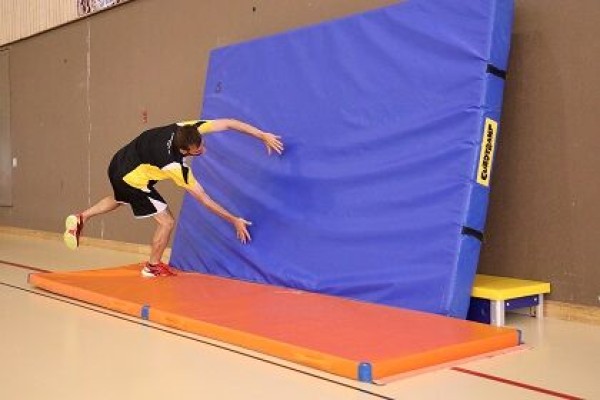
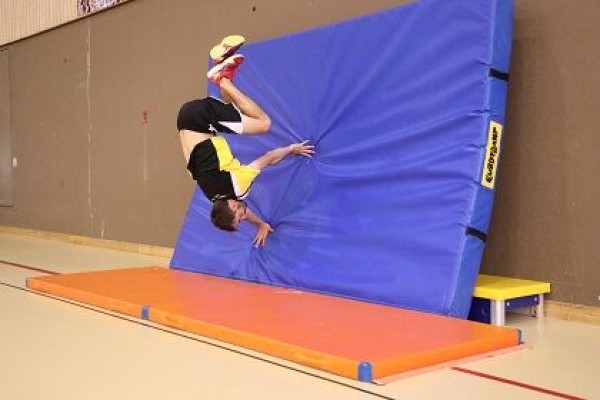

Approach the large soft mat at a 45-degree angle, place your hands in the centre of the mat (the upper hand points horizontally in the direction of the jump, the lower hand points towards the floor), jump with both legs and bring your legs tucked over your body to the other side (squat turn), land with both legs.
Variant:
Increase/decrease the angle of the large soft mat.
1 wall
1 vaulting box
1 soft mat (large)
1 soft mat (small)
Post setup:
Place the large soft mat at an angle against a wall and stabilise with vaulting box elements (i.e. place behind the mat), place the small mats in a row in front of the large soft mat.
Swivel squat IV
Parkour
Individual work
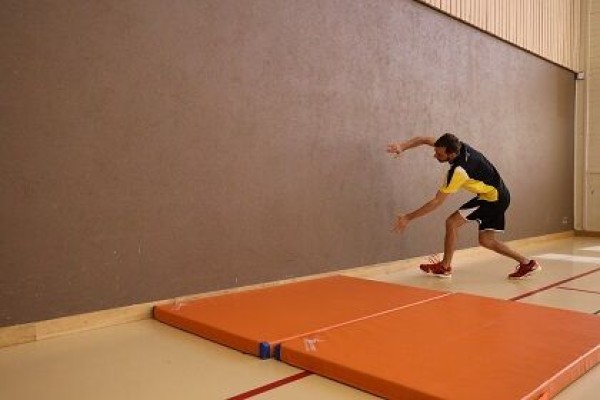
Approach the wall at a 45 degree angle, jump off with both legs, grab the wall with your hands (the upper hand points horizontally in the direction of the jump, the lower hand points towards the floor), pull your legs over your head to the other side (squat turn), land with both legs.
1 wall
1-2 soft mats (small)
Post setup:
Place soft mats on the floor in front of a wall.
Dribble artist
Coordination exercises
Individual work

Bounce two balls on the floor at the same or opposite time. After ten repetitions without interruption, switch to bouncing against the wall.
► Differentiation ability
1 wall
2 basketballs
Dribble artist
Coordination exercises
Individual work
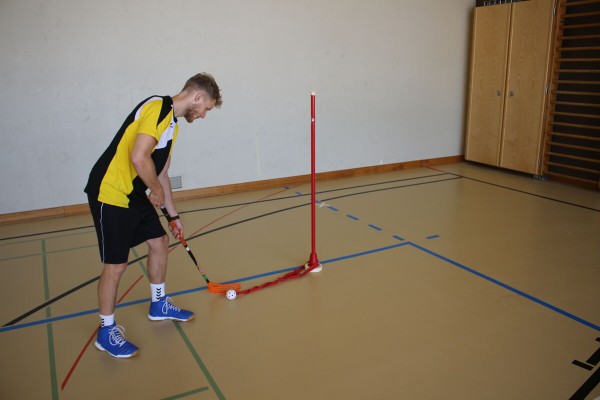
The participant uses the floorball stick to hit the ball clockwise and anti-clockwise around the stake with forehand and backhand strokes.
Variant:
If the ball is only attached with a ribbon (shorter pendulum), the exercise becomes more difficult.
►Rhythmisation skills, reaction skills
1 stake
2 game ribbons
1 floorball stick
1 floorball ball
Post setup:
A floorball ball attached to two linked game ribbons is placed loosely around a stake.
Dribble artist
Coordination exercises
Partner work
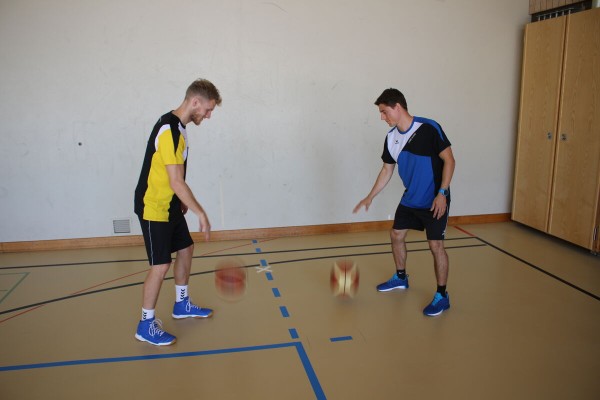
One participant bounces a rhythm with the (basket)ball, the second participant tries to copy the rhythm at the same time.
Variant I:
The imitator bounces twice or half as fast.
Variant II:
Perform the exercise alone with two (basket)balls, bouncing with one hand twice as fast as the other.
► Rhythm skills
2 basketballs
Dribble artist
Coordination exercises
Individual work
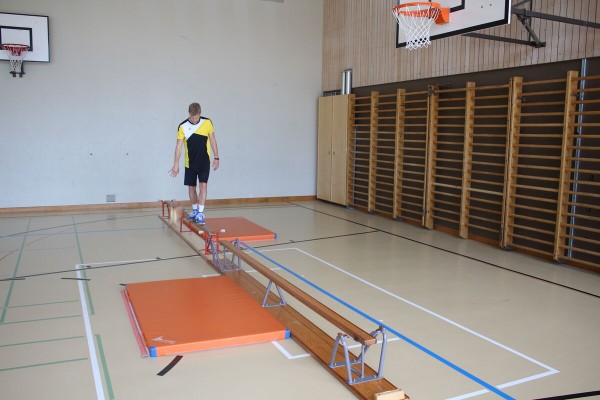
The participant runs across the narrow side of two long benches set up one behind the other and bounces a basketball. In the centre of the two long benches, the side on which the basketball is bounced is changed. Alternatively, or to make the exercise more difficult, two basketballs can be bounced at the same time.
Variant:
Small mats on the floor can make the exercise more difficult, as the side of the bounce must be changed (only possible with one basketball bouncing).
►Balance ability, differentiation ability
2 long benches
2 soft mats (small)
1-2 basketballs
Post set-up:
Place two long benches one behind the other with the narrow side facing up. Place a small soft mat next to each bench (on opposite sides).
Duel
Coordination exercises
Individual work
Two participants stand on the same slackline at the same time and try to stay up longer than their opponent. Who has 5 points first?
Easing:
Another participant sits in the centre of the slackline.
Heavier:
The participants each hold one end of a skipping rope and try to unbalance the other by pulling; the participants try to unbalance each other with a foam club or a foam ball.
1 Slackline
Dunking
Coordination exercises
Individual work

The participants jump onto the mini trampoline with the basketball in their hands and try to sink the ball into the basket with a basketball shot or even a "dunk".
► Rhythmisation skills, differentiation skills, orientation skills
1 mini-trampoline
1-2 soft mats (large)
4-6 soft mats (small)
1 basketball
Post set-up:
Place the large soft mat(s) under a basketball hoop and set up a mini-trampoline in front of it. For additional safety, place small soft mats around the large soft mat(s).
Swing through I
Parkour
Individual work
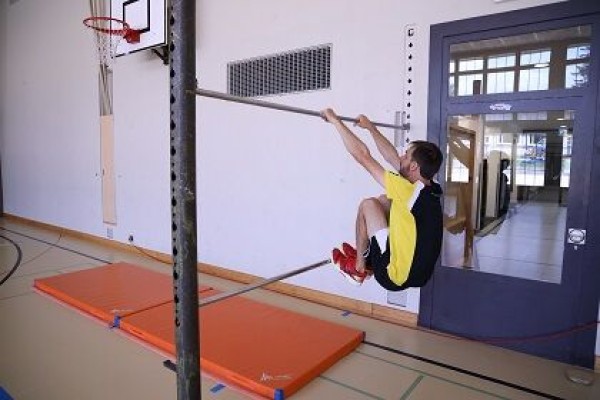
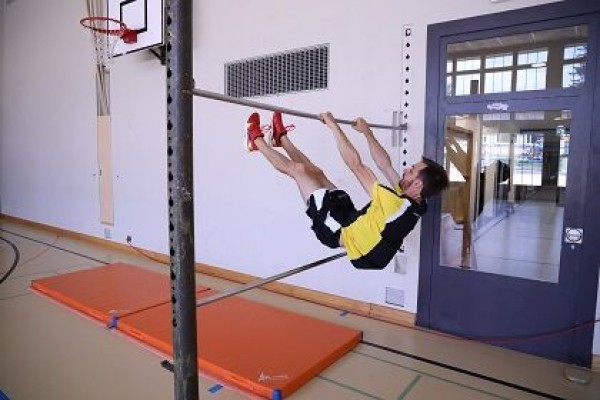
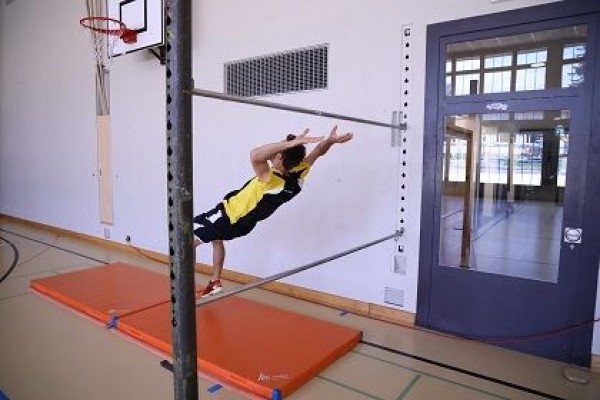
Squat on the lower horizontal bar, hold on to the upper bar with both hands, swing through between the two horizontal bars to land on the soft mat behind.
Variant:
Roll off after landing.
outdoor:
Stand on the front of the bar. Hold the pole with both hands. Swing under the (horizontal) bar to land on the other side.
1 horizontal bar ►indoor version
1 additional horizontal bar ►indoor version
2 soft mats (small) ►indoor version
Indoor pole assembly:
Fix two horizontal bars at different heights (approx. 1m apart).
outdoor:
1 pole
Swing through II
Parkour
Individual work
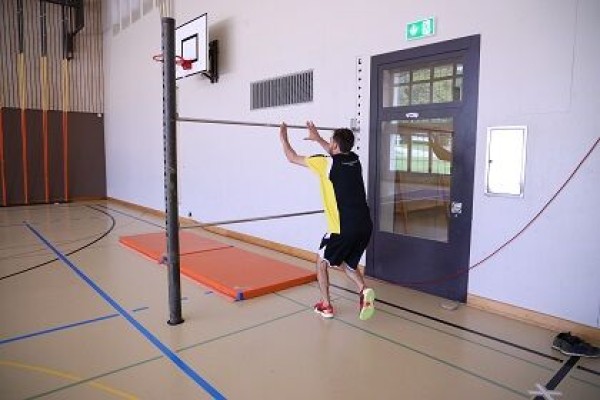
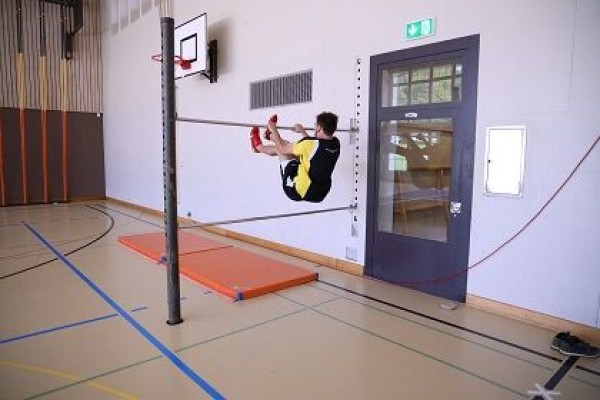

Frontal run-up and two-footed jump, hold on to the upper horizontal bar with both hands and swing between the two bars (underswing), two-legged landing on the other side (soft mat behind it ►indoor variation).
Variants:
Vary the height of the horizontal bars;
roll off after landing.
1 horizontal bar ►indoor version
1 additional horizontal bar ►indoor version
2 soft mats (small) ►indoor version
Indoor post setup:
Fix two horizontal bars at different heights (approx. 1m apart).
outdoor:
1 (horizontal) bar
Jump through I
Parkour
Individual work
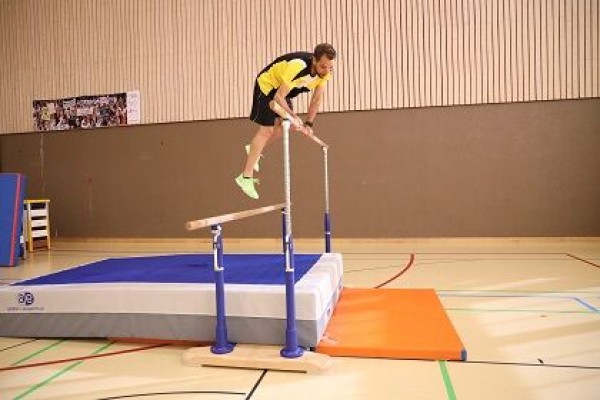
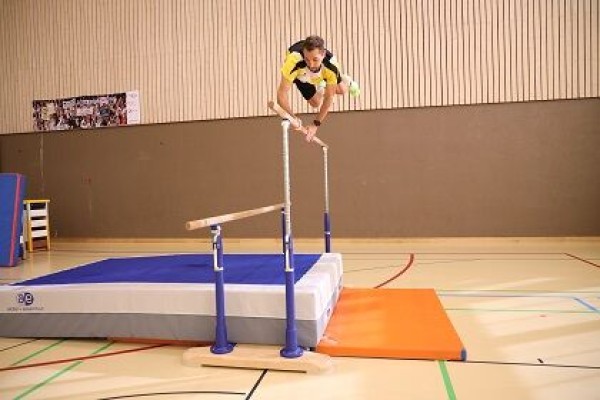
Stand on the low side of the uneven bars and hold on to the higher bars with your hands. Jump off with both legs for a squat turn over the high bars, landing on the small soft mat.
Variant:
Change the height of the bars.
1 parallel bars
1 soft mat (large)
1 soft mat (small)
Post setup:
Fix the parallel bars at different heights (distance: approx. 50 cm), place a small soft mat under the parallel bars and a large soft mat behind it.
Jump through II
Parkour
Individual work
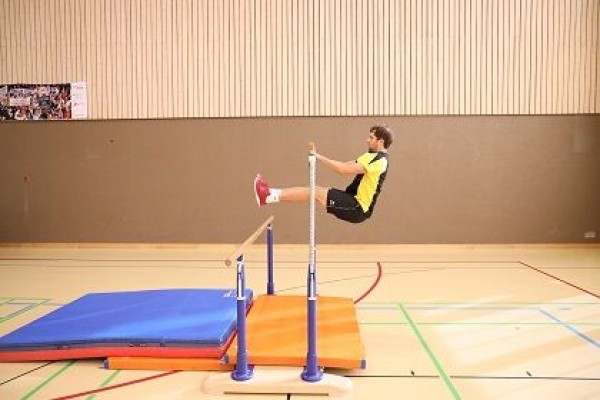
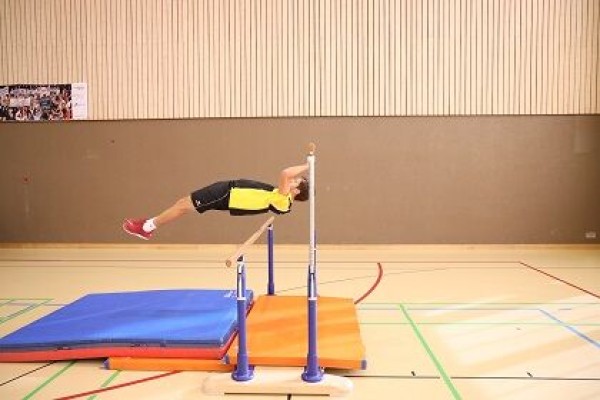
Frontal approach to the uneven bars (front: high bars), hold on to the upper bars and swing through the uneven bars (underswing). Land on the large soft mat.
Variant:
Increase/decrease the distance between the bars (both vertically and horizontally).
1 parallel bars
1 soft mat (large)
1 soft mat (small)
Post setup:
Fix the parallel bars at different heights (distance: approx. 50 cm), place a small soft mat under the parallel bars and a large soft mat behind it.
Jump through III
Parkour
Individual work
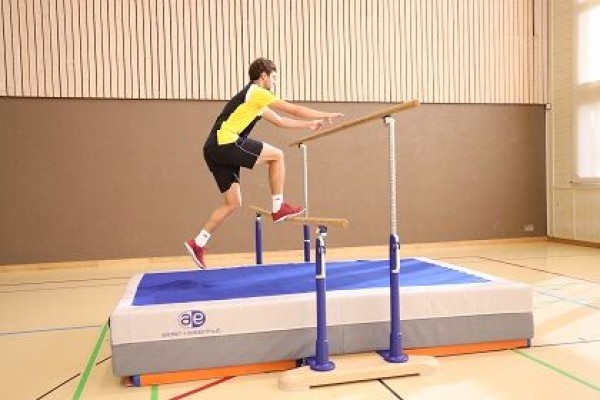
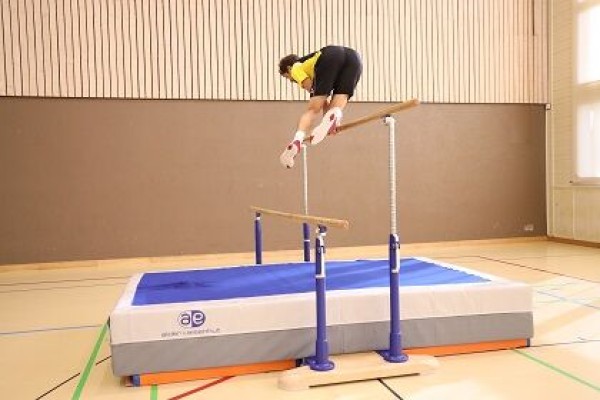
Frontal run-up to the uneven bars (front: low bars), jump onto the low bars, squat turn over the high bars (180 degree turn), landing with the feet on the low bars, hands still holding the high bars.
Variant:
Exit with underswing between the two bars without a support.
1 parallel bars
1 soft mat (large)
Post setup:
Fix the parallel bars at different heights (distance: approx. 50cm), place a large soft mat under the parallel bars.