
Exercises (3274)
Tyre guard
Forms of play / exercises
Group work
2 teams
Two teams play against each other in a limited playing area. A point is scored if a pass is made to a teammate who has at least one leg in a hoop. The defending team can block a hoop by placing a foot in it so that no points can be scored there (more hoops than defenders are needed for this type of exercise). The right to attack changes either after a certain time or after each loss of the ball or disc. The rules of the respective game form naturally apply (e.g. Smolball, Intercrosse/Lacrosse, Floorball, Frisbee Ultimate, Howler).
Variant I:
The exercise form can be played with all balls, throwing discs or game equipment. The throwing/passing technique or passing technique can be specified.
Variant II:
Use more than one ball.
Participant:
1 stick/stick ►Intercrosse/Lacross, Smolball, Floorball
1-3 balls ►Basketball, Blitzball/Touchrugby, Frisbee Ultimate, FooBaSKILL, Futsal/Football, Handball, Intercrosse/Lacross, Smolball, Tchoukball, Floorball
4 marking cones/caps ►Field markings (optional)
x hoops
x playing ribbons/rubbers ►Team identification
Tyre jumping
Coordination exercises
Individual work
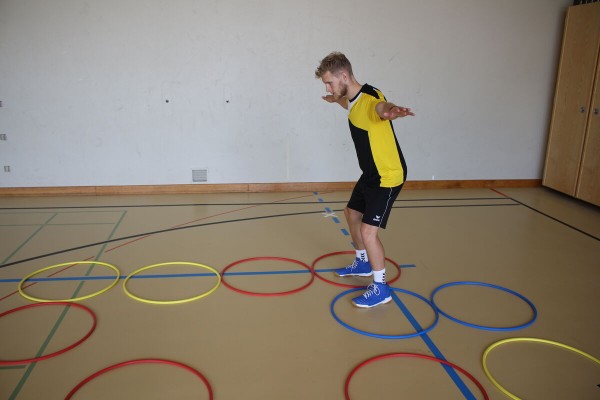
The participant hops over the tyres distributed on the floor. If two hoops are at the same height, both legs are used. Individual hoops are passed with the leg corresponding to the respective side. The hoops can be jumped through forwards or backwards. To make hoop jumping more difficult, the respective arm on the same or even opposite side can be lifted or stretched to the side at the same time when standing.
► Rhythmisation ability, orientation ability, balance ability
20-30 tyres
Post set-up:
Lay out the tyres to form a jumping course.
Tyre relay
Increase pulse
Group work
4-6 participants per group
The first participant in the group runs (alone) to the turnaround, slips through a tyre there and runs back to the group. Now the first participant runs with the second participant (holding hands) to the turning point, where they have to slip through the tyre again. The hands must not be released. This scenario is repeated until the entire group has slipped through the hoop (together with constant hand grasping). After this round, the first participant (who has travelled the longest so far) is allowed to disengage and the remaining group members continue the exercise. Finally, only the participant who was the last to join the group runs. At the end, all participants in the group have completed the same number of runs. Which group was the first to complete the task?
Per group:
2 colouring sticks
1 tyre
Tyre relay
Forms of play / exercises
Group work
4-6 participants per group
The first participant in the group runs (alone) to the turnaround, slips through a tyre there and runs back to the group. Now the first participant runs with the second participant (holding hands) to the turning point, where they have to slip through the tyre again. The hands must not be released. This scenario is repeated until the entire group has slipped through the hoop (together with constant hand grasping). After this round, the first participant (who has travelled the longest so far) is allowed to disengage and the remaining group members continue the exercise. Finally, only the participant who was the last to join the group runs. At the end, all participants in the group have completed the same number of runs. Which group was the first to complete the task?
Per group:
2 colouring sticks
1 tyre
Tyre pulling
Fighting and roughhousing games
Partner work
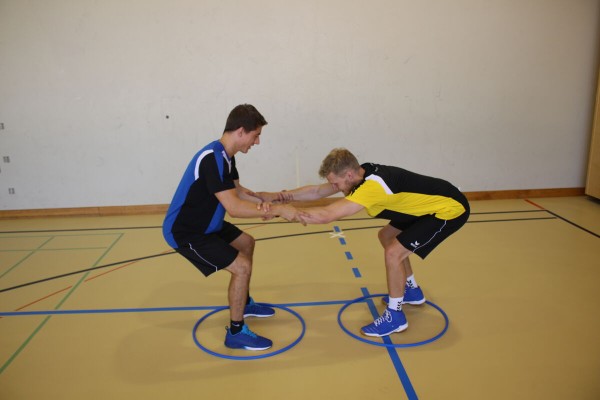
Two participants stand opposite each other in a hoop and grab each other by the hands or forearms. They try to push or pull their opponent out of the hoop. The first person to touch the ground outside the tyre loses.
2 tyres
Racing circle
Stimulate circulation
Group work
5-7 participants per group
The group forms an outer front circle with the participants' arms hooked into each other. At the start, the group sits on the floor. On a command, the group must stand up without the chain breaking apart and run to a defined point (e.g. around a turnaround, to the hall wall or across a specific line) and back again.
Variant:
Same exercise form as above, with all participants bending their upper body slightly forwards so that they touch each other with their buttocks. An egg (e.g. a medicine ball) is placed on the centre of the group and transported to a defined point and back.
Per group:
2 colouring sticks/marking cones/cones ►start and reversal mark (optional)
Per group:
1 medicine ball ►Variant
Reserve
Miscellaneous
The sports manager plans a reserve in the main part so that there is certainly no lack of time (e.g. additional breaks are necessary, postponement time could take longer, post changes are less speedy, etc.).
Rescue and transport
Power
Partner work
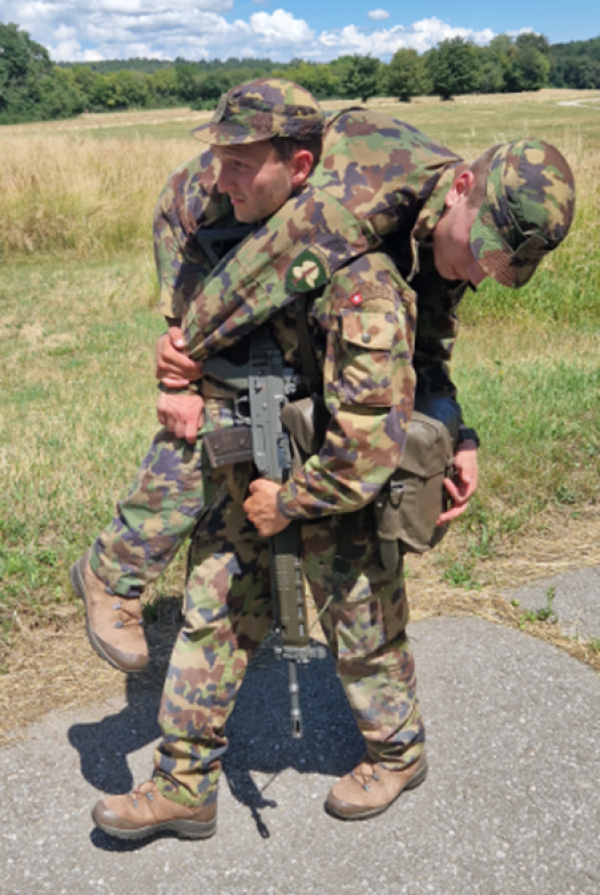
Transport your comrade from one fanjon to another (Gamstrage grip) using the transport techniques from the regulations for self-help and comrade assistance (59.005).
Attention:
The back must be straight when lifting the comrade.
Material per participant: Tenue CNG 428
Additional material: 2 fanjons
Rescue ball
Stimulate circulation
Group work
One or more catchers are required. The hunted participants have several rescue balls/throwing discs which they can pass to each other. Anyone holding the rescue ball/throwing disc cannot be caught. Anyone who is caught (touched by a catcher) performs an additional task (e.g. five stretch jumps followed by a push-up). The catcher(s) is/are replaced from time to time.
Per participant:
1 stick/stick ►Intercrosse/Lacrosse, Smolball, Floorball
Per group:
2-x balls/throwing discs (depending on group size) ►Basketball, Frisbee Ultimate, FooBaSKILL, Futsal/Football, Handball, Intercrosse/Lacrosse, Smolball, Tchoukball, Floorball
Per catcher:
1 game ribbon/stick ►
Risk run
Increase pulse
Group work
4-5 participants per group
The front runners compete against each other and collect points for their group. The runners choose between reversal points at different distances (e.g. colouring stick, marker cone or cones). More risk (further distance) is rewarded with more points, but only the first two (or more, depending on the number of groups) runners receive the points, the rest go home empty-handed. Which group has the most points after a run (each group member completes one run), or which group is the first to score a number of points? Each round only starts at the signal of the sports director.
Variant I:
The runner (or the group) may only start when a specified number is rolled. This allows the runner to gamble even more when collecting points as to whether they will be able to reach a more distant turnaround point before the other groups can start.
Variant II:
The sports leader specifies a time during which the groups can collect points (e.g. 7 seconds). At the sports leader's signal, the whole group runs off at the same time. However, each runner only goes as far as the obstacle (e.g. colouring stick, marker cone or cone) that they feel will get them back to the starting position in time. At the finish line, the group totals up the correct points collected. Which group can judge themselves best and collect the most points?
Variant III:
The runners take it in turns to run round the first, then the second and finally the third turning point (no risk run). Which final runner returns to the group first?
Types of transport:
- Pinch the frisbee between the knees
- Pinch the frisbee between the legs and hop along
- Complete the course in a four-foot gait (backwards), transporting the frisbee on the thighs or stomach
- Balance the frisbee on the head
- Transport the ball in or on the frisbee (depending on the top)
Per group:
4 colouring sticks
1 frisbee
1 dice
1 stopwatch
1 ball
writing materials
Risk run
Increase pulse
Group work
4-5 participants per group
The front runners compete against each other and collect points for their group. The runners choose between reversal points at different distances (e.g. colouring stick, marker cone or cones). More risk (further distance) is rewarded with more points, but only the first two (or more, depending on the number of groups) runners receive the points, the rest go home empty-handed. Which group has the most points after a run (each group member completes one run), or which group is the first to score a number of points? Each round only starts when the sports director gives the signal.
Variant:
The runner (or the group) may only start when a specified number is rolled. This allows the runner to gamble even more when collecting points as to whether they will be able to reach a more distant turnaround point before the other groups can start running.
Variant II:
The sports leader specifies a time during which the groups can collect points (e.g. 7 seconds). At the sports leader's signal, the whole group starts running at the same time. However, each runner only runs up to the obstacle (e.g. colouring stick, marker cone or cone) that they feel will get them back to the starting position in time. At the finish line, the group totals up the correct points collected. Which group can judge themselves best and collect the most points?
Variant III:
The runners take it in turns to run round the first, then the second and finally the third turning point (no risk run). Which final runner returns to the group first?
There are different exercise variations with the ball:
Single run:
- Carry ball
- Ball (e.g. medicine ball or gym ball). medicine ball or gym ball) in a high hold
- Carry the ball on your thighs in a four-footed gait
- Tuck the ball between your feet and bounce
- Bounce the ball
- Dribble the ball with your feet
- Roll the ball with your hands
In a binomial:
- Pinch the ball between the partners (hands must not hold the ball after the start)
Per group:
4 colouring sticks
1 ball (football, volleyball, basketball or handball)
1 dice
1 stopwatch
1 medicine or exercise ball
writing materials
Risk run
Increase pulse
Group work
4-5 participants per group
The front runners compete against each other and collect points for their group. The runners choose between reversal points at different distances (e.g. colouring stick, marker cone or cone). More risk (further distance) is rewarded with more points, but only the first two (or more, depending on the number of groups) runners receive the points scored, the rest go home empty-handed. Which group has the most points after a run (each group member completes one run), or which group is the first to score a number of points? Each round only starts when the game master gives the signal.
Variant I:
The runner (or the group) may only start when they roll a predetermined number. This allows the runner to gamble even more when collecting points as to whether they will be able to reach a more distant turnaround point before the other groups can start running.
Variant II:
The sports leader specifies a time during which the groups can collect points (e.g. 7 seconds). At the sports leader's signal, the whole group starts running at the same time. However, each runner only runs up to the obstacle (e.g. colouring stick, marker cone or cone) that they feel will get them back to the starting position in time. At the finish line, the group totals up the correct points collected. Which group can judge themselves best and collect the most points?
Variant III:
The runners take it in turns to run round the first, then the second and finally the third turning point (no risk run). Which final runner returns to the group first?
Per group:
4 colouring sticks
1 dice
1 stopwatch
writing materials
Risk run
Forms of play / exercises
Group work
4-5 participants per group
The front runners compete against each other (the group can determine the order of the runners accordingly) and collect points for their group. The runners choose between reversal points at different distances (e.g. colouring stick, marker cone or cones). More risk (further distance) is rewarded with more points (3 points, 2 points, 1 point), but only the first to arrive receives the points scored, the rest go home empty-handed only the first two (or more, depending on the number of groups, e.g. the first two teams) receive points. Which group has the most points after a run (each group member completes one run), or which group is the first to score a number of points? Each run only starts at the signal of the game leader.
Possible forms of locomotion:
- four-footed forwards/backwards
- in a push-up position with a partner holding the legs up
- gamstrage grip
Per group:
4 colouring sticks
Knight trapping
Stimulate circulation
Group work
2-3 catchers (labelled with bibs) try to catch the other participants by touching them. They can protect themselves with mats laid out in the hall (ejection tents in the field). The mats/spoiler tents may be lifted up by the hunted and used as protective armour (max. 5 seconds). The catchers may not touch the mats. Caught players fulfil an additional task (e.g. a strength exercise such as 5 push-ups).
x soft mats (small)/shooting tents (for in the field)
2-3 game ribbons/ribbons ►catcher
Robot game
Stimulate circulation
Group work
Groups of 3
Two "robots" start back to back. A "programmer" sets the robots in motion by touching the "on/off button" on their heads. If a robot is touched on the left or right shoulder, it makes a 90-degree turn to the corresponding side and continues moving. After starting the robots, the programmer may not issue any commands for five seconds. When a "robot" reaches a wall, it makes a 180-degree turn. The aim of the "programmer" is to bring the "robots" back together again.
Participant:
1 pair of poles (Nordic Walking)
Robot game
Stimulate circulation
Group work
Groups of 3
Two "robots" start back to back. A "programmer" sets the robots in motion by touching the "on/off button" on their heads. The "robots" move to the beat of the music (speed). If a robot is touched on the left or right shoulder, it makes a 90-degree turn to the corresponding side and continues to move. After starting the robots, the programmer may not issue any commands for five seconds. When a "robot" reaches a wall, it makes a 180-degree turn. The aim of the "programmer" is to bring the "robots" back together again.
1 music system incl. music (various)
Rollball
Increase pulse
Group work
2 teams
Two teams play against each other with a ball and try to score goals. The ball may only be rolled with the hands (no bouncing of the ball). A defined line between two cones, behind which the ball must be stopped, is used to score points.
Variant:
Use a hall wall, tilted long benches, box sections or goals to score points.
1 ball (football, volleyball, basketball or handball)
x bibs
2-4 long benches
4-6 boxes
4 goals
Roll backwards
Floor and apparatus gymnastics


From a standing position, roll backwards and place your feet on the floor behind your hands as quickly and as close as possible to return to a standing position. Curl your upper body like a turtle shell during the entire rolling movement from the top of your head to your tailbone. Roll over the upper back and shoulders and not over the head.
The participants practise the form of movement independently using series of pictures or based on the instructor's demonstration of the exercise. The instructor (or a partner) gives feedback, provides support and checks that the exercise is being performed correctly.
4 soft mats (small) ► indoor version
1 row
outdoor:
turf field
Roll backwards through the handstand (Streuli)
Floor and apparatus gymnastics


Roll backwards from an upright position, placing your feet on the floor as quickly and as close as possible behind your hands. Curl your upper body like a turtle shell during the entire rolling movement from the top of your head to your tailbone. Roll over the upper back and shoulders and not over the head. At the end of the roll, push your body into a handstand (full body stretch). The arms can be bent at first and then stretched or remain stretched throughout the movement. From the handstand, place the legs on the floor to return to the standing position.
In order to be able to perform this sequence of movements, it is necessary to be able to roll forwards and backwards, have appropriate support in the arms and master the tilt kick movement.
The participants practise the form of movement independently using series pictures or based on the demonstration of the exercise by the sports leader. The sports instructor (or a partner) gives feedback, provides support and checks that the exercise is being performed correctly.
4 soft mats (small) ► indoor version
1 row
outdoor:
turf field
Roll forwards and backwards
Floor and apparatus gymnastics


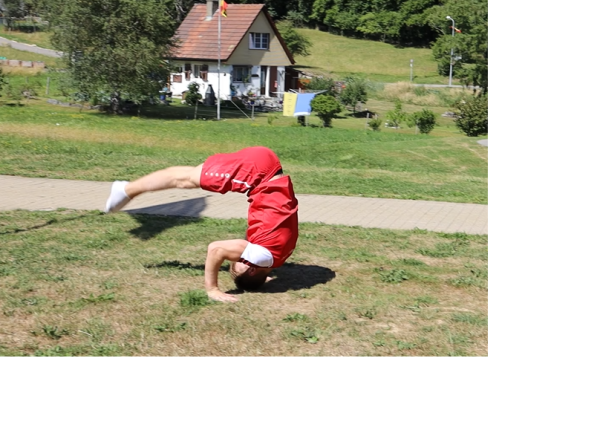


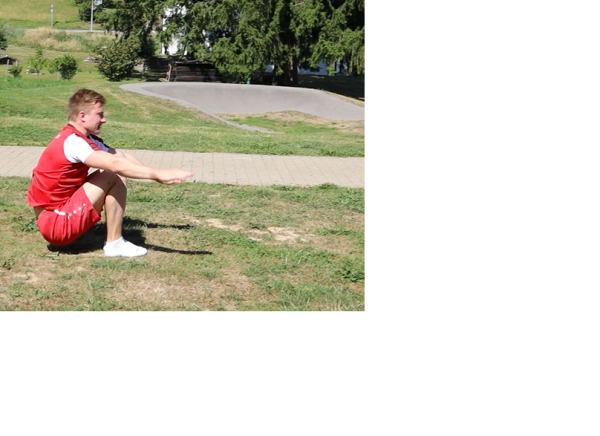


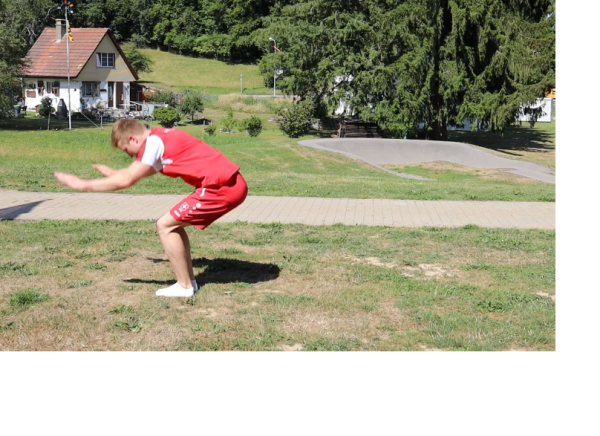


The two rolls are performed one after the other:
Roll fw:
From an upright standing position, perform a forward roll and land back on your feet without using your hands to stand up.
Roll rw:
From a standing position, roll backwards and place your feet on the floor as quickly and as close as possible behind your hands to return to a standing position. Curve the upper body from the top of the head to the tailbone like a tortoise shell during the entire rolling movement. Roll over the upper back and shoulders and not over the head.
The participants practise the form of movement independently using series of pictures or based on the instructor's demonstration of the exercise. The instructor (or a partner) gives feedback, provides support and checks that the exercise is being performed correctly.
4 soft mats (small) ► indoor version
1 row
outdoor:
turf field
Roll forwards
Floor and apparatus gymnastics


From an upright standing position, perform a forward roll and land back on your feet without using your hands when standing up.
The participants practise the movement independently using series of images or based on the instructor's demonstration of the exercise. The instructor (or a partner) gives feedback, provides support and checks that the exercise is being performed correctly.
4 soft mats (small) ► indoor version
1 row
outdoor:
turf field
Roll with raised arms and legs in lateral position left/right
Power
Individual work


Lay on your side, stretch your legs and arms and lift them slightly off the floor. Pull your navel towards your spine and consciously tense your abdomen and then change your side position without changing your body position (roll alternately to the right or left side).
Attention:
Stretched arms and legs practically form a line.
Lighten:
Just hold the position with your arms and legs raised and switch sides from time to time.
Harden:
Add weight to your arms and/or legs.
2-4 weight cuffs/2 weight balls/dumbbells ► Make the exercise more difficult (additional weight)
Rollmops
Stimulate circulation
Group work
2 teams
Two teams face each other behind two defined lines. In the centre of the two lines are 2-3 gym balls/kin balls/volleyballs, which are to be rolled behind the opponent's baseline or a defined line with targeted shots/throws by the participants (by hand, with the foot or with the playing equipment). Balls may only be shot at the target ball from behind one's own baseline. The throwing line, but not the centre line, may be crossed to retrieve the throwing balls. There are numerous balls in both throwing zones at the start of the game (e.g. handball, football, basketball, volleyball, floorball, etc.).
Caution:
It is forbidden to shoot/throw directly at the opposing team's players and care must be taken not to be hit by approaching balls when retrieving them.
Per participant:
1 racket/stick ►intercrosse/lacrosse, smolball, floorball
1-3 exercise balls/kine balls/volleyballs/medicine balls ►goals
x balls ►basketball, FooBaSKILL, futsal/football, handball, intercrosse/lacrosse, smolball, tchoukball, floorball
Rotation of the upper body in frontal stance to the wall (left) ► standing upper body rotation
Power
Individual work
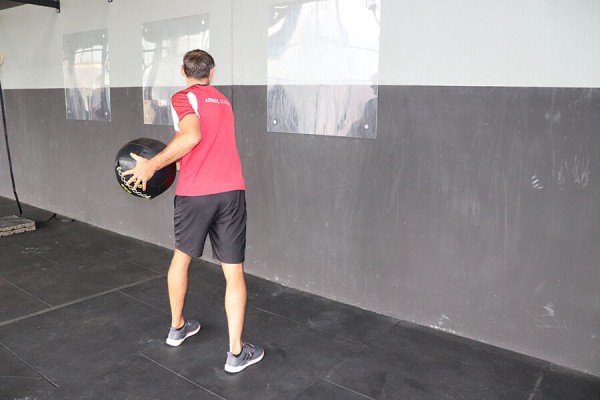
Stand upright in front of a wall, shoulder-width apart (facing the wall), with arms bent (approximately 90 degrees at the elbow joint), holding a medicine ball in front of the body with both hands slightly below chest height. The upper body is turned/rotated as far as possible to the left side (gaze follows the movement), while the legs and arms remain stable (lift the heel on the opposite side - right - as far as possible). Then swing the upper body back to the starting position and at the same time throw the ball (sideways) against the wall. Catch the ball and return to the starting position to restart the exercise.
Attention:
Tighten your stomach, keep your back straight, your pelvis remains in place and only your upper body moves.
Lighten:
Smaller movements (less rotation); lighter ball.
Harden:
Additional weight (on the arms); heavier ball; unstable base.
1 wall
1 medicine ball
1 volleyball or football ► make the exercise easier
2 weight cuffs ► make the exercise more difficult (additional weight)
1-2 balance cushions/1 balance board ► make the exercise more difficult (unstable surface)
Rotation of the upper body in frontal stance to the wall (right) ► standing upper body rotation
Power
Individual work

Stand upright in front of a wall, shoulder-width apart (facing the wall), with arms bent (approximately 90 degrees at the elbow joint), holding a medicine ball in front of the body with both hands slightly below chest height. The upper body is turned/rotated as far as possible to the right side (gaze follows the movement), while the legs and arms remain stable (lift the heel on the opposite side - left - as far as possible). Then swing the upper body back to the starting position and at the same time throw the ball (sideways) against the wall. Catch the ball and return to the starting position to restart the exercise.
Attention:
Tighten your stomach, keep your back straight, your pelvis remains in place and only your upper body moves.
Lighten:
Smaller movements (less rotation); lighter ball.
Harden:
Additional weight (on the arms); heavier ball; unstable base.
1 wall
1 medicine ball
1 volleyball or football ► make the exercise easier
2 weight cuffs ► make the exercise more difficult (additional weight)
1-2 balance cushions/1 balance board ► make the exercise more difficult (unstable surface)