
Exercises (2330)
Move your legs to the side while sitting alternately
Power
Individual work

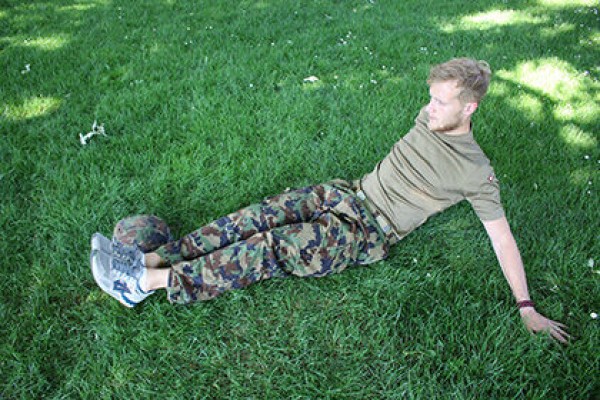
Sit on the floor, upper body slightly tilted backwards and supported by the hands, legs slightly raised from the floor in front of you and almost stretched out, alternately move the legs sideways over an object placed at foot level (e.g. helmet or rucksack), briefly tapping the floor with the heels on each side. Alternate legs sideways over an object (e.g. helmet or rucksack) placed at foot level, briefly touch the ground with your heels on each side.
Attention:
Do not put your feet down.
Lighten:
Legs bent more strongly.
Harden:
Legs extended; additional weight on/between the legs.
1 helmet/fighting rucksack
2 weight cuffs/1 PET bottle (1.5 litres)/ball/(additional) helmet/fighting rucksack ► make the exercise more difficult (additional weight)
Move your legs to the side while sitting alternately
Power
Individual work
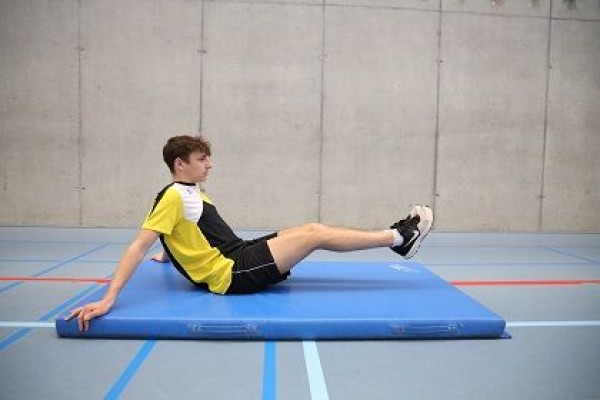

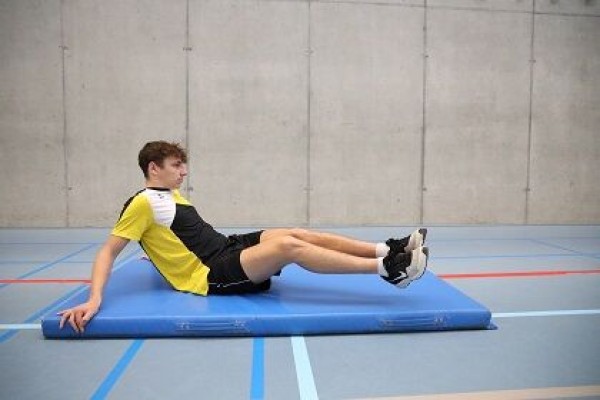
Sit on the floor, upper body tilted slightly backwards and supported by the hands, legs slightly raised from the floor in front of you and almost stretched out, alternate legs from one side to the other (optionally tap the floor briefly with your heels on each side).
Caution:
Do not put your feet down.
Lighten:
Bend your legs more.
Harden:
Legs stretched out; additional weight on/between the legs.
2 weight cuffs/1 (medicine) ball/weight disc/dumbbell ► make the exercise more difficult (additional weight)
Sequence of movements
Floor and apparatus gymnastics
The participants demonstrate a defined (or self-selected) sequence of movements to the sports leader (the group). The movements are practised by the participants beforehand.
Example of a possible combination:
- Forward roll
- Jump roll from standing position
- Stand balance
- Stretch jump with half turn
- Backward roll
- Handstand with roll-off
6-8 soft mats (small)
Movement tasks
Forms of play / exercises
Group work
The participants move freely with the ball (forwards, backwards, sideways, with speed variation) in the hall/area, with the sports instructor specifying various movement tasks. The exercises should be performed with both the stronger and the weaker side. Here is a possible selection of exercises:
- Balancing the ball on the racket
- Juggling the ball with the racket (forehand and backhand side as well as racket edge)
- Bouncing the ball on the ground
- Catching/stopping the ball every few steps with the racket in the air as well as on the ground
- Rolling/guiding the ball on the ground
Participant:
1 bat (Smolball)
1 ball (Smolball)
Big Jump
Parkour
Individual work
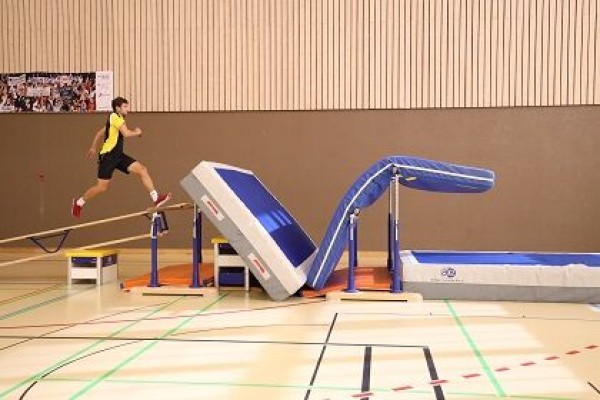
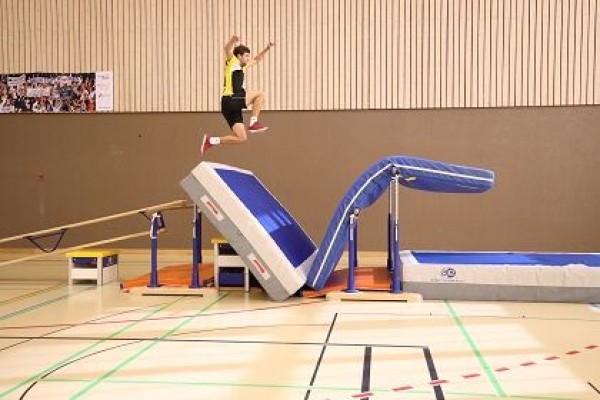
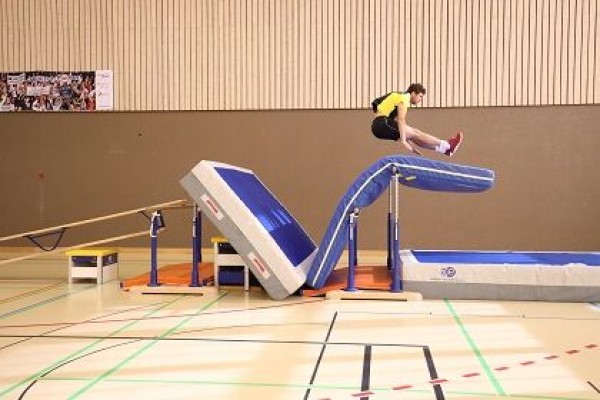
Approach over the long bench, jump onto/over the soft mat further away.
1 long bench
2 parallel bars
2 vaulting box
3 soft mats (large)
2 soft mats (small)
4 skipping ropes
Post set-up:
Exercise set-up as shown; the large soft mats are tied to the parallel bars.
Blitzball - Touchrugby
Games / Tournament
Game idea:
Two teams face each other on a playing field and endeavour to place a rugby ball in the opponent's target area by using their running speed and feinting hooks. The respective ball carrier can be forced by the opposing team to pass the ball backwards to a teammate, who then tries to penetrate the target area.
Scoring points:
A point is scored when an untouched player can place the ball behind the opposite target line in one of the three target areas. The centre target area scores three points, the side fields score 2 points each (indicated by marker cones).
Variant: a large soft mat is placed in the target area (centre); a point is scored by jumping onto the mat.
Playing field:
Field size 50mx34m for 6 players (3 against 3), 70mx48m (12 players), 100mx55m (18 players)
Number of participants:
3 against 3 to 9 against 9, depending on the field size
Rules of the game:
- The game is opened by means of a pass from the centre forward between the straddled legs to the back to a teammate.
- The ball may be carried forwards by any player, but may only be played/passed backwards.
- The player carrying the ball may be forced to pass it by hitting him on the back with his hand. The player in possession of the ball must then pass the ball on the third step or after two seconds at the latest.
- Jostling, clutching and pushing are not permitted, nor is hitting the ball.
- A free throw is awarded for all infringements of the rules, especially if the attacking team passes forwards. The free throw is always taken from the spot where the offence was committed.
- Except for the handshake on the back, Blitzball is played without any form of physical contact.
Blitzball: All against all
Forms of play / exercises
Group work
Two teams play against each other in a given field. The aim is to play as many passes as possible in the team before an opponent can intercept the ball or the ball falls to the ground. Whoever gets a pat on the shoulder from the opponent must pass. If the pass is intercepted or the ball falls to the ground, the ball changes hands and the other team can play the passes. Whoever has played the most passes after a predetermined time wins.
Variant:
10 passes result in one point. If a point is scored, the ball changes hands.
1 rugby ball
x game wristbands / covers ► team identification
Blitzball: Passing in a circle
Forms of play / exercises
Group work
5-8 participants per group (ideally groups of 6)
Each six participants form an outer front circle and pass a rugby ball around the outside of the circle. Round to the right / round to the left / ditto with two balls (aim: catch up with the other ball).
Per group:
2 rugby balls
Blocking
Light-Contact
Partner work
Presentation by leader.
The groups of 2 then practise the movements (including role reversal); the leader corrects them.
One way of blocking from the basic position is simply to turn out the respective hand and bring it forwards (crosswise) in order to ward off/block the attacker's punch with the palm of the hand (fist against palm).
Participant:
1 pair of boxing gloves
Block / evasive manoeuvre with counterattack
Light-Contact
Partner work
Presentation by leader.
The groups of two then practise the movements (including role reversal); the leader corrects. If necessary, an exercise sequence is also performed in the group.
This sequence of movements combines blocking and dodging with a counter (lead hand and punching hand). One participant slowly strikes 4x in the direction of their partner's forehead (2x left/right). The defender blocks the punches twice (left/right) and then dodges twice and simultaneously performs a counter-punch (left/right).
Blocking:
When blocking, the respective hand is turned out from the basic position and brought forward (crosswise) to ward off/block the attacker's punch with the palm of the hand (fist against palm).
Leading hand:
When countering with the leading hand (example left side), the front foot remains stable in place, the weight is shifted to the rear (right) foot (tilt the upper body backwards slightly). To avoid the opponent's punch, the body weight is not only shifted backwards, but the upper body is also tilted to the side (outwards - to the right). Finally, you follow up with your own punch (jab) with the (left) lead hand (on the "inside" side).
Punching hand:
When countering with the punching hand (example right side), you take a step to the (left) side (sidestep), shifting your weight to the front (left) foot. Finally, the own punch (straight) follows with the stronger hand (on the "inner" side).
Exercise:
In groups of 2, the blocking and dodging including the counter punch is practised. This involves blocking and dodging twice on one side and then on the other (lead hand and punching hand). The sequence of movements is practised very slowly at first; the speed can only be increased once the sequence of movements has been completely mastered. The roll can be changed after each pass or after several passes. In order to gain more confidence in the sequence of movements, it is advisable to do several passes in succession. It also makes sense to change partners from time to time (variety and different levels of participants). The instructor can make the exercise more difficult by no longer clearly defining the attacking side (e.g. 2 attacks each to block and evade - side arbitrarily determined by the attacker - change roles - change partners).
Participant A: 2x punch left + right (jab + straight) / Participant B: Block left + right plus dodge with counter (lead hand and punching hand)
Variant:
All participants perform the sequence of movements (= participant B; see above) together (same front - rotate the alignment by 90 degrees after each pass). The instructor counts slowly from 1-4 for the individual steps (block left - block right - dodge incl. counter with the lead hand - dodge incl. counter with the punching hand). The instructor takes the opportunity to make corrections.
Participant:
1 pair of boxing gloves
Blocking with punching hand
Light-Contact
Partner work
Constant role and partner changes
.Position:
Elbows close to the upper body, arms remain where they are in the boxing position, slight shoulder rotation against the punch (3cm).
- Participant A: punch with lead hand
- Participant B: block with punching hand
- Participant A: punch with lead hand, block with punching hand
- Participant B: Block with punching hand, counter with jabbing hand
Variation:
Apply what you have learnt in a short 1:1 match (slowly + carefully; don't hit too hard at the beginning).
Participant:
1 pair of boxing gloves
Ground contact
Partner acrobatics
Group work
Groups with 3-10 participants
The participants form groups of 3-10 people. The sports leader specifies the number of limbs that may touch the floor within the group. Through skilful acrobatic exercises and a little ingenuity, the groups fulfil the sports leader's specifications.
No material required
Floor press
Fighting and roughhousing games
Partner work
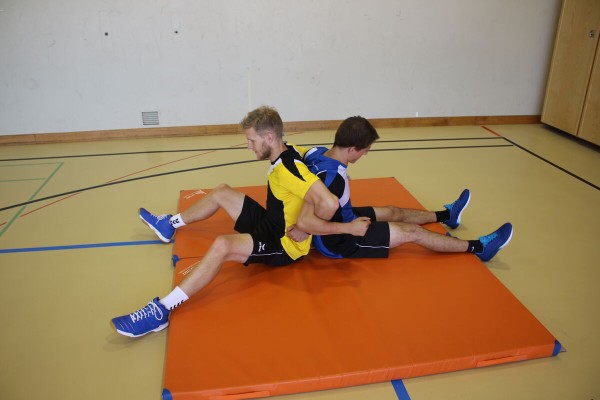
The participants sit back to back with their legs slightly bent in the centre of a mat/lawn area. The participants' arms are interlocked. The aim is to press the opponent's right or left shoulder to the ground. The side is changed with each pass.
2 soft mats (small) ►indoor version
2 tent groundsheets ►outdoor version
Indoor post assembly:
Connect the soft mats to each other on the wide side using Velcro.
Crane Jump
Parkour
Individual work
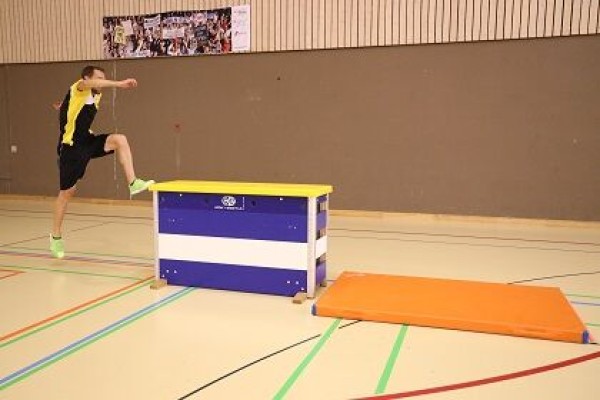
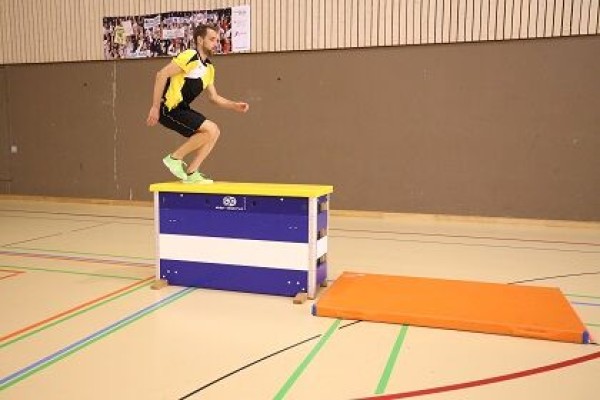
Short run-up to the vaulting box (obstacle - e.g. wall ► outdoor variant), one-legged jump from the run, landing with the other foot on the box (step jump).
Variant:
Place a lower vaulting box in front of the vaulting box (2-3 elements) and jump in a step jump first onto the small box and then onto the large box.
1 vaulting box ►indoor version
1 soft mat (small) ►indoor version
2-3 vaulting box elements incl. top section ►variation of the exercise
Indoor set-up:
Place a soft mat behind a vaulting box.
Variation: Place a lower box in front of the vaulting box.
outdoor:
A raised obstacle (wall or similar).
Endurance run
Basic training
Group work
In (small) groups according to running speed or individually
An endurance run in (small) groups (based on running speed) or individually on a flat course. The running speed remains constant the whole time (choose the appropriate speed depending on the strength class).
Course: loop; from A to B; from A to B and back again
Intensity level: 2-3 (easy-medium)
Hmax: 70-90%
Rule of speech: chatting - speaking in full sentences
Attention:
The course must be known or clearly signalled to all participants.
Variant:
Change the course of the route (e.g. integrate inclines).
Signalling (e.g. route tape)
Evaluation FTA (group formation)
Participant:
1 heart rate monitor
Endurance run with increased intensity
Basic training
Group work
In (small) groups according to running speed or individually
An endurance run in (small) groups (based on running speed) on a flat course. The running speed is increased from time to time (choose the appropriate pace depending on the strength class), but the specified intensity levels are maintained.
Course: loop; from A to B; from A to B and back again
Intensity level: 1-3 (very easy-loose-medium)
Hmax: 60-90%
Speaking rule: sing-chatter-speak in full sentences
Caution:
The course must be known or clearly signalled to all participants.
Variant:
Change the course (e.g. integrate inclines).
Signalling (e.g. route tape)
Evaluation FTA (group formation)
Participant:
1 heart rate monitor
Daumenjudo
Fighting and roughhousing games
Partner work

Two participants hold hands crosswise with their thumbs in the air. On command, both try to catch the opponent's thumb with their own thumb and press it down. The winner is the one who can hold their opponent's thumb for two seconds. Switch sides after each round.
No material required
Cover work
Light-Contact
Individual work
From the shoulder-width boxing position, a tennis ball is bounced with one hand while the other hand is always held at the temple. The participant moves freely on their feet as if on a track (forwards, backwards, sideways - also in a circle, bouncing the tennis ball at the same point).
Variant:
A fight between everyone (or duel): the participant whose tennis ball touches the floor or is held twice in succession completes an additional task (press-ups, stretch jumps, squats). The opponent's tennis ball may be touched, but there is no physical contact.
1 Tennisball
Cover work
Light-Contact
Group work


Exercise 1:
Static form: From the shoulder-width boxing position, bounce a tennis ball (in a hoop) with one hand, keeping the other hand on your temple at all times. Change which hand is bouncing the tennis ball from time to time.
Exercise 2:
Dynamic form: Move the tennis ball between the rings (bouncing on the feet) without touching them.
Exercise 3:
On a command from the instructor ("top"), swap the tennis ball with a partner.
Exercise 4:
At the instructor's command ("top"), try to steal another participant's tennis ball without losing your own ball.
Exercise 5:
All against all (elimination match): whoever loses their ball is eliminated (possibly perform additional tasks).
Per participant:
1 tennis ball
1 tyre
Diagonal stand
Coordination exercises
Individual work
Place one foot and the opposite hand on the slackline, stretch out the other limbs (horizontally) and hold the position. The closer the hand and foot are to each other, the less stable the position is; if they are further apart, you need good body tension.
Elevate:
Tap marked points on the ground with your hand; cat walk (move forwards from a diagonal position).
1 Slackline
Thief jump I
Parkour
Individual work
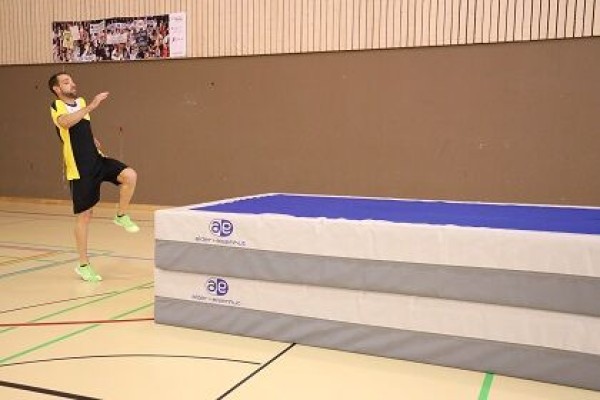
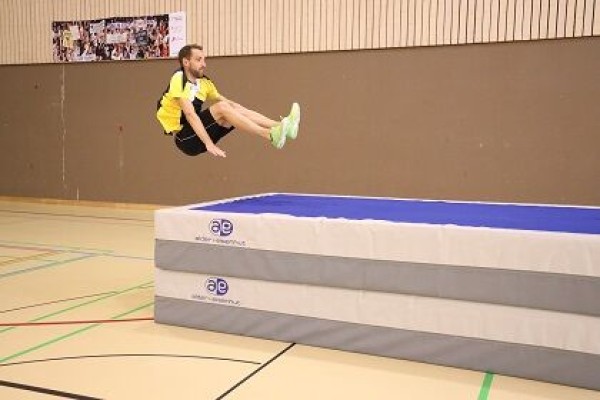
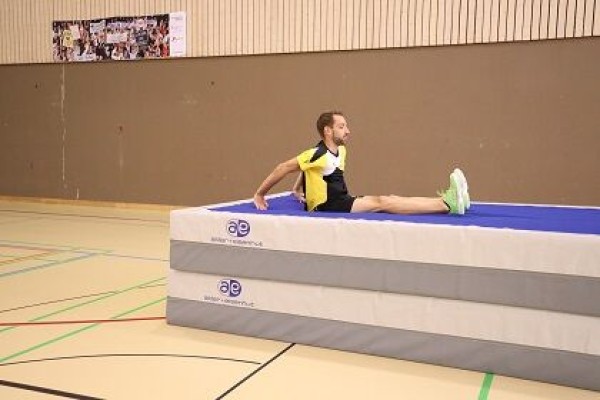
Strong run-up, frontal take-off approx. one leg length in front of two soft mats lying on top of each other, pull your legs up quickly in the air and bring them forwards in a horizontal position, hit the mat hard with both hands when landing in the seat.
Variant:
Lower mat height (only 1 soft mat).
2 soft mats (large)
Post structure:
Place two large soft mats on top of each other.
Thief jump II
Parkour
Individual work
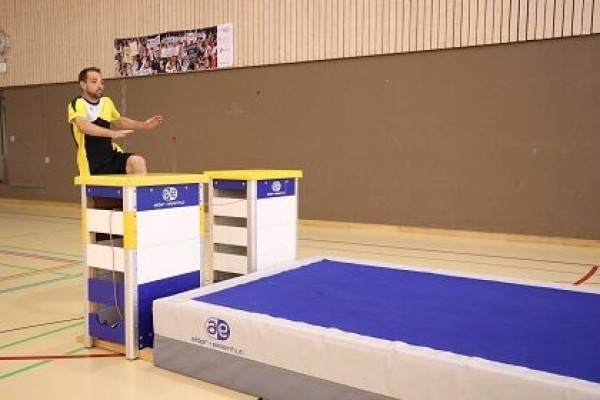

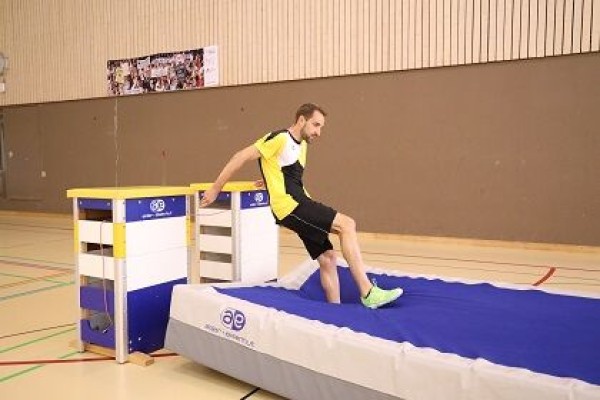
Strong run-up, frontal take-off approx. one leg length in front of the obstacles, pull your legs up quickly and bring them forwards in a horizontal position, push off the vaulting box with both hands.
Variant:
Vary the height of the box.
2 vaulting boxes/pommel horses
1 soft mat (large)
1 elastic rubber band
Post set-up:
Place two vaulting boxes next to each other at a distance of approx. 50 cm, place a large soft mat behind them, stretch an elastic rubber band between the vaulting boxes if necessary
Thief jump III
Parkour
Individual work
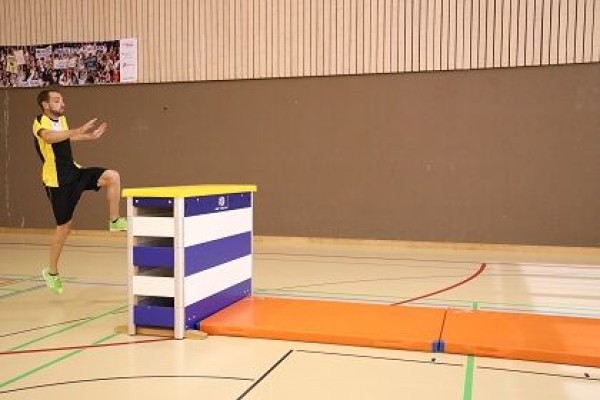
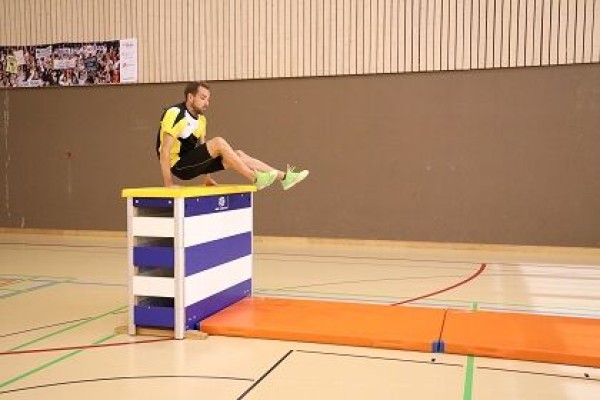

Strong run-up, frontal take-off approx. one leg length in front of the vaulting box, pull your legs up quickly and bring them forwards horizontally, push off the box forcefully with both hands to land, continue running directly after landing.
Variant:
Vary the height of the box.
1 Swedish box/pommel horse
Distance collector
Coordination exercises
Individual work
The participants form two groups, each of which is assigned to a slackline. Now the participants, one after the other, walk as far as possible along the slackline. The distances travelled by the individual participants are added up. Which group covers a greater distance
Difficulty:
Only metres walked backwards count
1 Slackline
Double passing game
Coordination exercises
Partner work
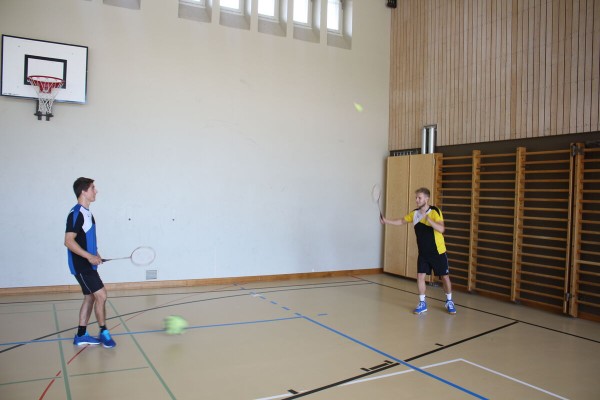
Two participants stand opposite each other at a distance of 3-5 metres and simultaneously pass a football and a shuttle back and forth with badminton rackets.
Variant:
Pass the football and shuttle at the same or opposite pace.
► Differentiation skills, orientation skills, reaction skills
Per group of 2:
2 badminton rackets
1 badminton shuttle
1 football